
Behind the Work
The Painting Process
Every piece begins with the land — its light, its weight, its silence. Here is how a painting comes to life.
Paint as Material, Not Just Medium
I work primarily in oils, chosen for their slowness. The extended drying time allows me to push, scrape, and build the surface over days and weeks — responding to what the painting asks for rather than what I planned.
The physical texture of my work is not decorative. It is structural. Ridges of impasto catch light differently at different times of day. A painting in morning light is not the same painting at dusk. That changeability is something I actively pursue.
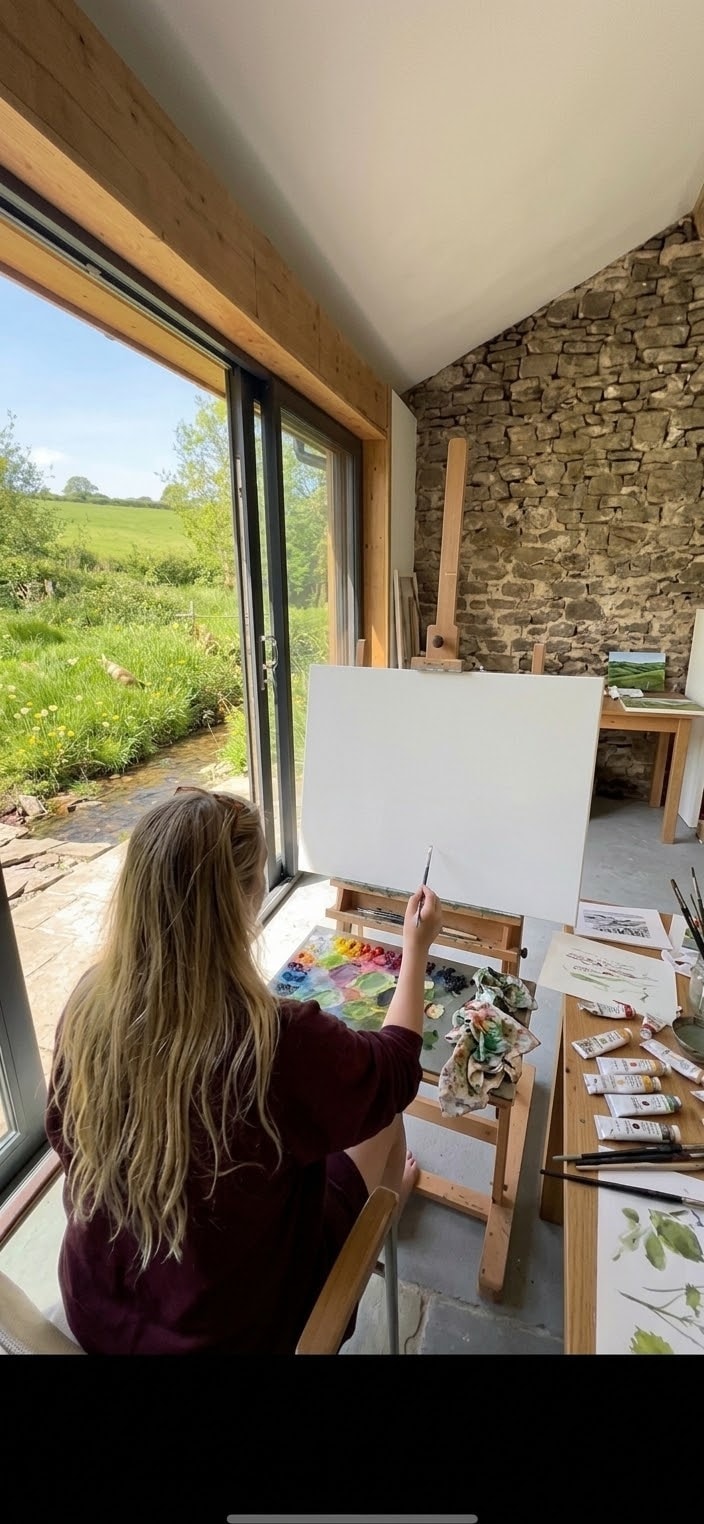
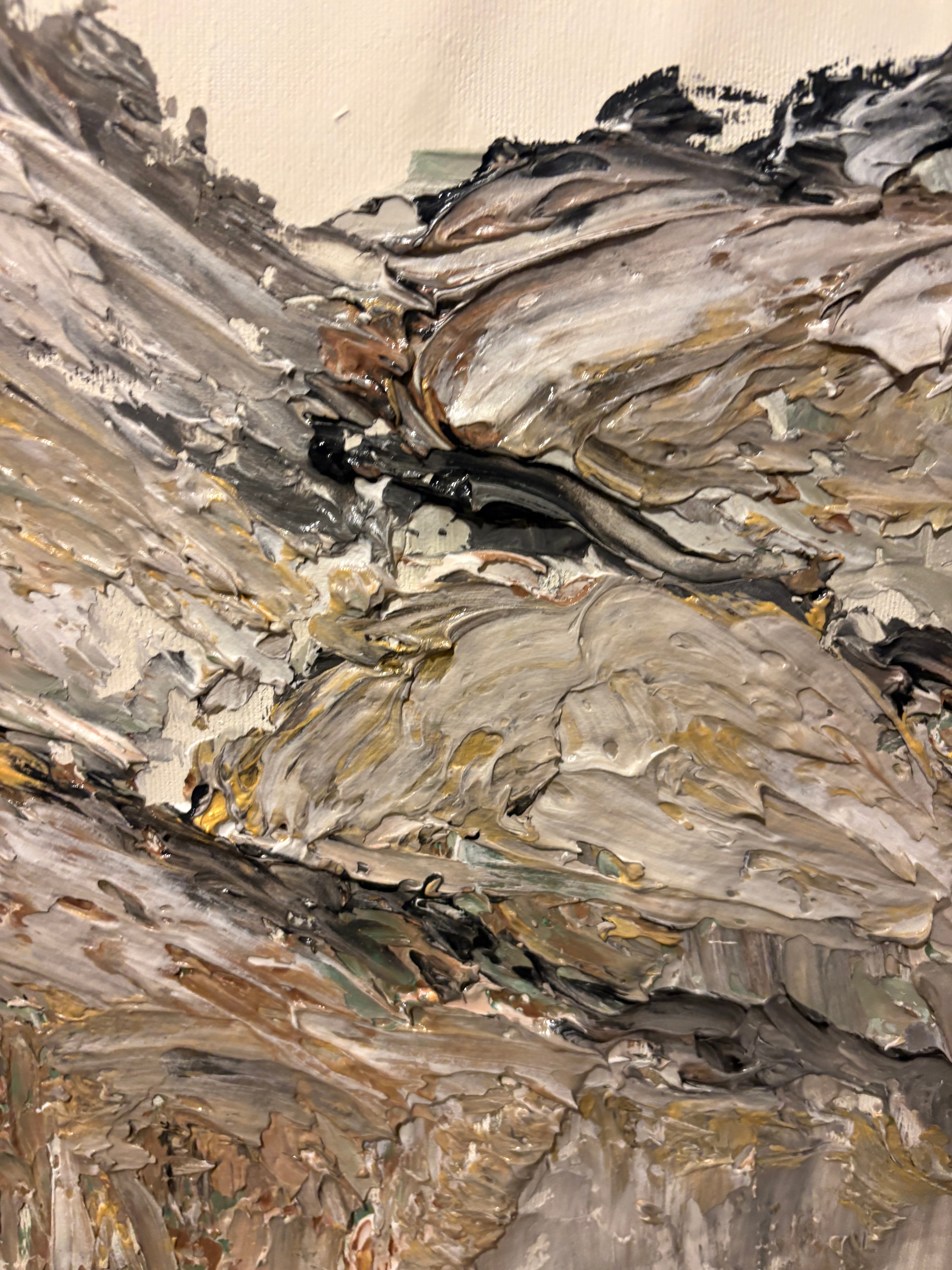
From Ground to Varnish
Ground & Preparation
I begin on deep-edge canvas or linen board, primed with several layers of gesso, sometimes tinted with raw umber or yellow ochre to warm the ground. The surface is sanded between coats to create a fine tooth that holds the first layers of paint without slipping.
Underpainting
A loose, thinned underpainting maps the composition in broad tonal masses — no detail, just the architecture of light and dark. I use burnt sienna or raw umber thinned with Zest-It, which dries quickly and gives me a warm foundation to work against.
Building the Surface
This is where the work becomes physical. Paint is applied with palette knives, hog bristle brushes, and sometimes fingers. Layers are built up wet-into-wet in some areas, allowed to dry and scraped back in others. The surface accumulates history — earlier marks remain visible beneath later ones.
Texture & Impasto
Impasto passages — thick, raised paint — are applied with a palette knife in a single decisive stroke. These areas catch raking light and create genuine shadow within the painting itself. I use cold wax medium in some works to extend the paint and add translucency to the heavier passages.
Gold & Metallic Detail
Where gold leaf or metallic paint appears, it is applied late in the process — pressed into still-tacky paint or laid over a dried surface with size. It is used sparingly, as punctuation rather than decoration: a horizon line, a reflection, the edge of a form emerging from shadow.
Resolution & Varnishing
A painting is finished when nothing more can be removed. I live with each work for several weeks before varnishing with a conservation-grade matte or satin varnish, which protects the surface and unifies the sheen across thick and thin passages.
Materials
Paint
Professional-grade oils — Winsor & Newton Artists' and Michael Harding. Pigment-rich, slow-drying, lightfast.
Support
Deep-edge linen canvas and canvas board. Primed with multiple coats of gesso, hand-sanded between layers.
Tools
Palette knives of varying sizes, hog bristle brushes, soft synthetic brushes for glazing. Cold wax medium for texture and translucency.
Gold
23.5 carat loose gold leaf and metallic oil paint. Applied with size or pressed into wet paint.
Varnish
Gamvar conservation-grade varnish. Removable, UV-resistant, applied 6–12 months after completion.
On Making
I am drawn to landscapes that resist easy description — the moment before a storm breaks, the particular quality of light on still water, the way distance flattens colour. These are not places I paint from photographs. They are places I carry with me.
The process of painting is, for me, a process of forgetting what I know and paying attention to what is in front of me. The best marks are the ones I did not plan. The surface of a finished painting holds all of that — the decisions, the revisions, the moments of not knowing.
See the Work
Each original painting is available to purchase and ships worldwide, carefully packaged to protect the surface.